|
Zeiss IOLMaster Customer Service: 1-877-486-7473 ext.
4030
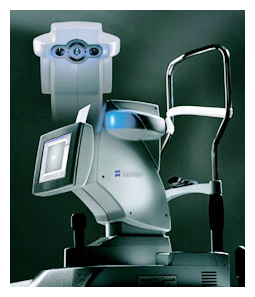
IOLMaster — Overview.
Intended Use
The IOL Master is to be used only for the measurement of axial
length, corneal radii, anterior chamber depth and optionally for
the determination of "white-to-white" of the human eye,
as well as for the calculation of the required intraocular lens.
Responsibility for using the IOLMaster other than as intended lies with
the user.
The IOL Master may only be used in combination with accessories delivered
by Carl Zeiss Meditec.
Please consult Carl Zeiss Service regarding the use of other accessories.
Package Contents
The IOLMaster is delivered in completely assembled form, packed in foam
material.
The enclosed accessory box contains the following
components:
Save the original packaging for storing the IOLMaster during extended
periods of non-use or for returning it to Carl
Zeiss Meditec, or dispose
of it properly.
Functional Description
The IOLMaster is a combined biometry device for measurements on the
human eye required for the preoperative computation of intraocular
lens power.
It is capable of fast and precise consecutive measurement of the
following eye parameters in one session: axial length, corneal
curvature, anterior chamber depth and optionally "white-to-white". All
measurements are non-contact, providing excellent patient comfort.
The axial length measurement is based on a patented interference
optical method known as partial coherence interferometry (PCI).
The displayed results of the axial length measurements are compatible with
the ultrasonic immersion measurements of axial length via the use
of an internal, statistically verified calculation algorithm. The familiar
formula for IOL calculation can thus be used.
However, the lens constants must be changed for use with the PCI method.
Please consult the scientific literature on this subject.
The corneal curvature is determined by measuring the distance between
reflected light images projected onto the cornea.
The anterior chamber depth is determined as the distance between
the optical sections of the crystalline lens and the cornea produced by
lateral slit illumination.
"White-to-white" is determined from the image of the iris.
The individual measurement procedures are automated, so that the operator
is only required to adjust the device to the patient’s eye and initiate
the measurement. For this reason the complex biometry of the eye can be
rapidly learnt with the IOLMaster, but should be practised with the greatest
of care and attention to detail.
Extensive integrated safety features (independent redundant hard and
software safety features) ensure maximum safety for both the patient
and operator when using the IOLMaster.
The control program for the computer in the IOLMaster base runs under
Windows. A backlit LCD serves to observe the patient's eye and
display the readings. The IOL Master is controlled by the joystick and computer
keyboard with integrated touch-pad.
Based on the readings, the program can make suggestions for
the choice of intraocular lens strengths. The latter are based
on internationally accepted calculation formulas. The Haigis, HofferQ,
Holladay, SRK II and SRK/T formulas are implemented in the software.1
The Haigis-L formula may be used to calculate IOL's following
myopic LASIK/PRK.1
The refractive history or contact lens method may be used to correct
the measured corneal radii/refraction following refractive corneal
surgery.1
Selected phakic lens implants may be calculated with the Phakic
IOL tab.1
An IOL database is likewise implemented. Prior to calculation,
the latter must be filled with data for the desired lens.
On the basis of postoperative refraction results, the lens constants
entered into the calculation formulas may be optimized (personalized)
for each individual user.
References1
Literature on the formula (for specific questions contact
Carl Zeiss Meditec):
- Haigis: http://ocusoft.de/ulib/
- HofferQ:
HOFFER KJ: The Hoffer Q formula: A comparison of theoretic and regression
formulas. J Cataract Refract Surg, 19:700-712, 1993; ERRATA 20:677, 1994
- Holladay:
HOLLADAY JT, PRAGER TC, CHANDLER TY, MUSGROVE KH, LEWIS JW, RUIZ RS: A
three-part system for refining intraocular lens power calculations. J Cataract Refract
Surg, 14:17-24, 1988
- SRKII:
RETZLAFF J: A new intraocular lens calculation formula, Am Intra-Ocular Implant
Soc J 6:148-152, 1980
- SRK/T:
RETZLAFF J, SANDERS DR, KRAFF MC: Development of the SRK/T intraocular lens
implant power calculation formula. J Cataract Refract Surg 16 (3):333-340, 1990
- Haigis-L:
HAIGIS W: publication in preparation
- Correction of corneal radii/refraction after refractive corneal surgery:
- HOLLADAY JT: IOL calculations following RK Refract Corneal Surg. 5(3):203, 1989
HOFFER KJ: Intraocular lens power calculation for eyes after refractive keratotomy.
J Refract Surg. 11:490:493, 1995
- Calculation of phakic implants:
vd HEIJDE GL, FECHNER PU, WORST JGF: Optical consequences of implantation of
a negative intraocular lens in myopic patients. Klin MB1 Augenheilk 192:99-102,
1988
HOLLADAY JT: Refractive power calculations for intraocular lenses in the phakic
eye. Am J Ophthalmol 116:63-66, 1993
HAIGIS W: Biometry in complicated situations, 9th DGII Convention 1995, Rochels
et al (publ.), Springer, 17-26, 1996
|




 IOLMaster Checklist (pdf)