Correction of Astigmatism - Mesa, Arizona.
AcrySof Toric Lens Implant for Cataract Surgery.
Now, patients with cataracts and astigmatism have another option — the
AcrySof Toric Lens, which corrects for both conditions simultaneously.
Implanted in the eye to restore vision after cataract surgery, the AcrySof
Toric lens implant is an artificial lens specifically designed to provide
both spherical and astigmatic correction. We invite you to make an appointment and learn more: 480-981-6111.
About Astigmatism:
Whether myopic or hyperopic, most eyes have corneal astigmatism to some
degree. Corneal astigmatism means that the front part of your eye, the
clear window you look through, is not perfectly round. Instead of being
spherical like a basketball, an astigmatic cornea is slightly flattened,
more oval in shape like a football, with one side steeper than the other
(as illustrated above).
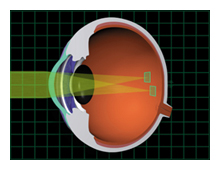
Because the astigmatic cornea is curved more (steeper) in one direction
than the other, light entering the eye is refracted differently as
it passes through these different areas. This causes light to come
into focus at several different points on the back of the eye, rather
than ideally coming into focus at just one point (note the illustration,
right).
Depending on the direction and the amount of astigmatism, vision through
an astigmatic cornea will be affected in various ways. The illustration
(below) gives a broad example of the visual effects, depending on the
overall direction of the curve:

Limbal Relaxing Incisions For Astigmatism Correction.
It is most common for eye surgeons to simply prescribe glasses or contact
lenses for the correction of astigmatism after cataract surgery. Some
surgeons will treat corneal astigmatism at the time of cataract surgery
by placing "limbal relaxing incisions" (LRI's). This involves
making tiny incisions in the cornea to "relax" or flatten the
steeper meridian, thereby causing the corneal curvature to become more
rounded, reducing astigmatism.
| |
 |
These long, thin incisions are placed at the very edge of the cornea
(known as the corneal limbus) on the steepest meridian, and differ in
number and length according to the amount of astigmatism. Relaxing incisions
generally do not eliminate corneal astigmatism completely, but rather
reduce it to an acceptable level. Because the cornea is living tissue,
there may be "over-response" or "under-response" to
these incisions. Seldom is corneal astigmatism completely resolved; however,
a significant reduction in your astigmatism produces a more satisfactory
uncorrected visual result.
Some patients with extreme amounts of astigmatism may still require
the addition of limbal relaxing incisions to correct astigmatism after
cataract surgery with the AcrySof toric lens. For the patients, with
unusually high amounts of astigmatism, implanting the toric lens means
that less corneal surgery in the form of a limbal relaxing incision is
needed to achieve the same amount of correction.
In the future, the AcrySof Toric Lens Implant will be available in higher
powers of astigmatic correction so that even very high amounts of corneal
astigmatism can be corrected without the addition of limbal
relaxing incisions.
For more information: Alcon Toric Lens Implant
Make your appointment today with East Valley Ophthalmology, to see if
the AcrySof Toric lens for the correction of astigmatism is right for
you.
The eye specialists of East Valley Ophthalmology perform advanced
technology diagnostic testing and treatment, as well as taking
the time necessary to provide each patient with information needed
to fully understand their condition and to achieve their best possible
visual outcome.
If you would like further information, please call our office at:
480-981-6111
East Valley Ophthalmology
Eye Doctors - Mesa, ArizonaIf you or a family member
or friend have not had a recent routine eye examination, have a specific eye condition that needs addressing, or are looking for
an eye specialist or professional eye consultant please take a moment to Request an Appointment.
|