Cataract Surgery Specialists - Mesa, Arizona.
An Amazing Transformation of YOUR Vision!
Nationally and internationally acclaimed, East Valley Ophthalmology
physicians are among the leading eye surgery specialists in the United States, and recognized as experts around the world. We have
established ourselves as the place where other
doctors send their difficult and unusual cases. Consistently at the forefront of scientific developments, East Valley Ophthalmology
specializes in the mathematics of intraocular lens
power calculations (the lens that replaces the cataract), and in offering
cataract patients options only recently available to others. 
Three Exciting Advancements:
- Premium Intraocular Lens Implants
- Correction of Astigmatism
- Intraocular Lens Power Calculations
Premium IOL's (intraocular lens implants) and surgical methods for the
correction of astigmatism in conjunction with advanced
intraocular lens power calculations now allow many cataract patients the possibility of reducing their need for glasses after cataract surgery.
Why did I get cataracts?
Learn about vision and cataract surgery.
Two Lenses - one outside, one inside.
To understand the formation of cataracts, it may be easiest to begin by covering how the eye works and what happens to it as you age normally.

There are two lenses that are responsible
for seeing clearly. They bend the light going into your eye to focus on the "retina" - a network of nerves at the back of the eye. The retina relays the information it receives from the light to your brain and you "experience" seeing.
The Outside Lens: The lens on the front of your eye, the clear outermost, dome-shaped structure, is called the "cornea".
The Inside Lens: The lens inside your eye is called the "crystalline lens" or just the "lens". It is located behind the colored part
of the eye called the "iris".
Both the cornea and the crystalline lens must
be perfectly clear if your vision is to be crisp and clear. While the cornea typically
maintains its clarity throughout life, the
crystalline lens may undergo a number of changes as you age. If you are over 40 years old it is likely that you have started
to experience some of the changes in your vision that each and every one of us
will encounter. Even if you have had “normal” eyesight all your life,
as you age your vision begins to change in a several distinct ways. The most obvious changes involve the inside lens.
Presbyopia - why you need reading glasses.
One of the earliest changes that you will experience
occurs when the lens inside your eye loses its flexibility. This is called "presbyopia", the inbility to accommodate (or change) your vision so you can see both near and far, depending on where you place your attention.
Up until the age of approximately
40, the inside lens is both crystal clear and quite soft
and flexible. This flexibility permits the lens to change its
shape and alter its curvature so that it can help focus your vision at various
distances - from far to near, to arms length, to far or near again. Around
the time we enter our 40's, this lens begins to stiffen,
and it becomes progressively more difficult to change focus. Usually this lessens our ability to easily see closer objects - at arm's length or reading material. This loss of
flexibility is called Presbyopia (click
on link for more information).
Cataracts - why your vision seems cloudy.
As the inside lens loses it flexibility, it is often followed by another
type of change: the lens loses its transparency. As you progress
through your 50's and 60's, the normally crystal clear lens very gradually
becomes yellow and cloudy. You may not even notice it happening until one day you notice your ability to see well
in dim illumination, such as for night driving, is impaired. What happened? This cloudiness may also create
glare, light sensitivity, or an overall decrease in your vision. If parts
of the lens become too cloudy they may cause a significant decrease
in both your day and night vision. The cloudy, yellowed
lens is called a Cataract (click
on link for more information).
About Cataract Surgery.
Cataract Surgery - the only "cure" for cataracts.
Cataract surgery today is safe, effective and quite
common. In fact, if you have been told that you have a cataract, you are
definitely not alone. Each year in the United States, more than 2.5 million
people have cataract surgery. Is there a non-surgical cure?
Thanks to advanced cataract surgical procedures
and lens implant technology, cataract surgery is not only one of the most
frequently performed surgical procedures in the United States, but it is
also one of the safest and most successful surgical procedures that you can
have. Cataract surgery is performed on an outpatient basis and usually only
requires a few hours of your time from beginning to end.

TOP
How is Cataract Surgery Performed?
 Warren E. Hill, MD, FACS
Board Certified Ophthalmologist
|
|
Cataract surgery today is quite comfortable. First, the procedure will begin
with your eye being treated with an anesthetic so that you will feel little
if anything during your surgery and minimal if any discomfort.
Your eye surgeon
operates while looking through a highly specialized microscope, designed
exclusively for this purpose. A very small, beveled incision, less than 1/8
of an inch, is made at the edge of the "clear cornea". The clear
cornea is the transparent covering of the front of the eye.
The incision is
just large enough to allow a microscopic instrument the size of a pen tip
to pass through it. Once the microscopic instrument is actually passed through
the tiny incision, ultrasound from the tip of the microscopic instrument
will be used to gently break the cataract into pieces small enough to be
washed away, drawn through the instrument and removed from the eye.
Through the tiny incision, a microsurgical, ultrasonic, oscillating probe
is inserted, which gently fragments the cloudy lens, using high frequency sound
waves. Simultaneously, this same instrument suctions out the fragmented pieces.
This process is called "phacoemulsification". The posterior capsule, an elastic bag-like membrane that held the lens, is left in place.
The incision is commonly called "self-sealing" because the eye's
natural internal pressure holds the incision tightly closed allowing the eye
to heal without stitches. The chances of developing astigmatism (distorted
vision) after surgery are significantly decreased by eliminating stitches,
which tend to pull the eye's surface slightly out of its natural shape.
Once all the minuscule bits of the cataract have been removed, a tiny new
clear implant lens is folded, inserted through the small incision, and allowed
to open up inside the posterior capsule.
The surgery typically takes 20-30 minutes, and is performed on an outpatient
basis. This means that you will have the surgery and then go home, usually around 30 minutes afterwards. Most of the time only local anesthesia is used, so you will be awake for the entire process. After the surgery, you are taken to the recovery
room and then released. You will need someone to drive you home.
Premium Lens Implants for Correcting Presbyopia
In the past, all lens implants were of
a type called a "monofocal" lens implant. A monofocal lens implant
provides excellent vision after cataract surgery, for one set distance
only — usually
for seeing things at a distance and thus does not correct presbyopia,
meaning it does not enable you to see close objects or read without reading
glasses or bifocals. For seeing at a distance, such as looking at signs when
driving, going to a movie or going to a ball game, a monofocal lens implant
will provide the vision you need to see clearly. With a monofocal lens implant
you will most likely need to wear eyeglasses for any type of near vision
activities, such as reading, sewing, playing cards or
writing, which would require you to wear glasses.
Today, we are able to offer you the choice of a presbyopia
correcting multifocal lens implant. A presbyopia correcting multifocal lens
implant provides excellent vision after cataract surgery at a variety of
distances. Depending on your specific vision requirement, there are several
types of presbyopia correcting multifocal lens implants that your eye surgeon
might suggest, including the ReStor Lens Implant.


Each of these lens implants or intraocular lenses (IOL) works in
a different way to help you achieve your vision correction goals of being
able to see at a variety of distances after cataract surgery, without being
dependent on eyeglasses. Presbyopia correcting multifocal lens implants correct
both your distance vision and your presbyopia after cataract surgery. For
the vast majority of patients, having a multifocal lens implant means that
you will be able to see at distance and up close with less dependence
on eyeglasses. So, patients choosing to have a presbyopia correcting multifocal
lens implant will likely find that they can drive, watch television, read
or do crafts without the need for glasses. Patients choosing multifocal lens
implants typically experience a greater overall freedom from glasses allowing
them to participate in most everyday activities without dependence on, or
the hassle of glasses. Follow this link for more information on Lens Implants for Cataract Surgery.
TOP
Cataract Surgery FAQs.
Can eye drops can prevent or dissolve cataracts?
No — The Food and Drug Administration has not approved any drops that cure or delay cataracts. Some such products claim they can prevent cataracts, but cataract formation is a natural part of the eye's aging process. Other products claim they can "dissolve" cataracts. But since cataracts are not a "substance" on the lens, there is nothing for the drops to dissolve. There is no "cure" for catarcts other than the surgical removal of the inside lens and it's replacement with an artificial lens (IOL).
Do close-up tasks like reading or sewing make cataracts worse?
No — Cataracts are not caused by how people use their eyes. However, cataracts likely become more noticeable during close work. One sign of a cataract is the need for more light to do the same activities well.
Are cataracts reversible?
No — The lens naturally clouds as it ages. This process is unavoidable. However, its progress can be slowed by quitting smoking, eating a balanced diet, and wearing sunglasses with 100% UVA and UVB protection.
Can cataracts "grow back?"
No — Cataracts develop as the lens's cells die and accumulate; they are not a "growth" that sits on top of the eye. Occasionally patients do develop a different, secondary cataract. When the membrane that holds the new lens implant becomes cloudy, vision can be compromised. But this can easily be treated with laser surgery, a painless, 15-minute procedure usually done at a doctor's office.
Are lasers used to remove cataracts?
| |
 Dr. Neal Nirenberg, MD, FACS
Board Certified Ophthalmologist |
No — Lasers do not remove cataracts. Cataracts are removed
using ultrasonic sound waves, not laser light.
However, lasers are used for
the removal of "capsular haze", which is a thin film of scar tissue
that occasionally forms on the posterior capsule behind the new implant lens.
This haze is harmless and painless, and it occurs in a small percentage of
cataract surgery. Patients sometimes think their cataract has "grown
back",
but it hasn't. Once a cataract has been removed, it will not reoccur.
A special Nd:YAG laser is used to remove capsular haze by the following
— An opening is made in the scar tissue with the laser, allowing vision
to be restored. With modern intraocular lens implant designs, and materials,
the incidence of posterior capsule clouding has fallen to approximately one
percent. Click
here for an inside view of scar tissue removal by laser.
Is cataract surgery scary or painful?
 A strange new world. |
|
It is perfectly normal to be a bit apprehensive
before any unfamiliar experience. All this information about cataracts
and surgery may seem odd or a little frightening to you. That's okay
because we are here to walk you through it and make everything as
simple and smooth as possible.
Our patients most often report that their surgery was remarkably
pleasant, and that pain was not even a consideration. Some have even
told us that they haven't felt that relaxed in years!
At East Valley Ophthalmology, we promise to be attentive to your
needs and well-being and will do everything possible to make sure
you are completely comfortable throughout the entire procedure. You
will be given a relaxant to enhance calmness and will neither see
nor feel any part of your eye surgery. After you are released, we
will call you that evening to see that you are doing well. The next
morning, you will visit with your physician for evaluation and to
address any concerns you might have. We are always here for you.
Is cataract surgery dangerous, and recovery takes months?
No — Cataract surgery is one of the safest and most highly perfected surgical procedures in medicine, with a 95% success rate. Of course, as with any surgery, risks do exist and should be discussed with your eye doctor before the procedure. Patients will need to avoid bending or lifting anything heavy for up to three weeks after the procedure, as well as refrain from rubbing or pressing the eye. Normal activities may be resumed the day after surgery. Cataract patients often notice vision improvement immediately following surgery, and others will notice more gradual improvement for a few months afterward.
Do both eyes have cataract surgery at the same
time?
No — Cataract surgery is best performed on one eye at a time, to enable you
to use one eye while the other is healing. They are typically scheduled
two weeks apart.
How long do lens implants last?
Assuming your eye is normal and healthy, the intraocular lens implant should
last your entire lifetime. Lens implants are not known to "wear out."
TOP
What are the risks of cataract surgery?
| |
 Modern
cataract
surgery:
advancements worth celebrating!
|
Cataract surgery is one of the most successful of ALL surgeries, but just as
it can be risky to cross an empty street, as with any surgery, there are
some risks involved. The only way to avoid all risk is to do nothing.
Complications
are possible during or after cataract surgery even with the most excellent
care. Those complications most commonly seen are associated with unusual eye
anatomy (very long or very short eyes), certain inherited eye diseases, and
prior trauma. Such complications include bleeding, infection, glaucoma,
corneal clouding, swelling of the center of the retina, retinal detachment,
decreased vision, or in exceptionally rare cases, loss of the eye itself. While
it is impossible to predict in which patients these complications will occur,
the risk of these complications is very small.
There are times when a cataract can be removed successfully but vision is
not improved — because of other conditions or diseases of the eye. One
such disease is macular degeneration,
where the
central part of the retina — the area that is critical for "fine" seeing — is
damaged. Occasionally, macular degeneration cannot be diagnosed prior to the
cataract removal because the presence of the cataract itself may prevent
seeing the macula in sufficient detail. It is sometimes only after the cataract
is removed that macular degeneration is diagnosed.
In addition, other pre-existing conditions of the eye can limit vision after
cataract surgery, such as diabetic
retinopathy or glaucoma.
All such pre-existing conditions limit the eye's ability to regain normal vision,
even if the cataract surgery itself is a huge success.
All that said, remember that cataract surgery has a
high success rate, higher than any other surgical procedure. It is most likely
that your vision will be remarkably better and that your quality of life
improved.
What Is the cataract recovery time?
Not so long ago, cataract surgery involved making an incision large enough
to remove the clouded lens in one piece. Patients were often stayed at the
hospital overnight or for several days. With the aid of new technologies,
now cataract surgery can be performed through a very small incision
and usually occurs on an
outpatient basis, with a significantly shorter recovery time.
The day following your surgery, you will have an office appointment to
ensure that you are healing properly. Your vision could be blurred from ointments
associated with eye surgery or you might see quite clearly. Every patient
is an individual and heals somewhat differently. Over the following weeks,
visual clarity progressively improves, and after one month, the eye is typically
healed and ready for refracting for new glasses, if needed. Follow-up visits
are usually scheduled for the next day, one week, and then one month after
surgery. During this time you will be using eye drops to help the eye to
heal and to prevent infection.
TOP
Will cataract surgery impact on my activities?
| |

It is a good idea to accept some
assistance after cataract surgery. |
Your sight will usually improve within a few days, although complete healing may take several months. It is a good idea to have some help at home if you can, especially if you find it difficult to put your eye drops in.
For the first four days following cataract surgery, we ask you to avoid
any and all heavy lifting or bending over that bring your head below the
level of your heart. After that, and for the month following surgery, you
can resume most of your normal activities, but minimize lifting, bending,
and straining. Carrying reasonably lightweight objects, such as a purse or
a small bag of groceries, is usually fine.
You will also be asked to avoid getting water in the operated
eye for one to two weeks. Avoid swimming. Water that is normally safe for showering
and drinking has bacteria in it, and this can possibly cause an infection
where the incision was made in your eye. Just adjust your routine to wash
your hair leaning backwards rather than forwards, for example. Or better
yet, treat yourself and have someone else wash it for you!
You don't need to stay indoors,
but try to avoid being out in the wind, as something might blow in your eye.
You'll need to keep your hands out of your eyes as well. Your surgeon may
give you an eye-shield to wear at bedtime to inhibit possible rubbing or
pressing on the eye in your sleep. Avoid eye make-up for six weeks. As for
returning to work or driving, this varies from one patient to another and
the kind of work involved. Discuss your situation with your doctor who is
here to address all of your concerns.
Will I see better after cataract surgery?

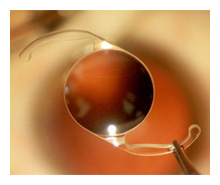
AcrySof IQ lens implant inside the eye.
This eye is "dilated" (pupil is enlarged)
- otherwise you would
not see the lens.
|
|
Well over 95% of cataract surgeries improve a patient's vision. If having
a cataract is the only cause of your decreased vision, removing it will improve
clarity. If you have an additional problem (such as macular
degeneration, prior
uveitis, retinal detachment, diabetic
retinopathy, or glaucoma), a determination will be made by your ophthalmologist as to which issue needs
to be addressed, and when. Cataract surgery can be successfully carried out
even in the setting of most of these other eye conditions
Will I need glasses after cataract surgery?
| |

You may or may not have
to wear glasses for reading.
|
Depending on your eyes and refraction, and the type of lens
implant that is chosen,
you may or may not have to wear glasses for reading or distance.
Once a cataract
has been removed, light can once again pass undistorted through the cornea
and the newly implanted artificial lens, to the retina in the back of the
eye. However, you may still be required to wear glasses to see more clearly
because the incoming light needs to be focused directly on the retina. If
you eye cannot do so on its own, eyeglasses will be needed to provide that
focus.
In addition, the implanted artificial lens cannot change shape for close
vision the way a natural, youthful lens does. A natural lens accommodates,
or changes shape, to bring objects into focus at distance, or close up. The
intraocular lens implant provides clearest vision at a single focal distance,
with the great majority implanted to correct for distance vision. This means
that an eye focused for distance will have sharpest vision for activities such
as driving, but, if you do not qualify for an accommodating
lens implant, you would still require bifocal lenses or reading glasses
in order to see clearly at close range.
How do I prepare for cataract surgery?
 East
Valley Ophthalmology utilizes the most modern technology available.
|
|
A comprehensive eye
examination is the
first step. During your
examination for cataract surgery, you will be evaluated for any special medical
risks. Your eyes will be measured with the most up-to-date technology, including
the Lenstar® or IOLMaster®, to determine
the proper power of the intraocular lens that will be inserted during surgery.
Be sure to inform your eye surgeon of all medications you are
presently taking, and ask if you should continue your usual dosages. When your
cataract surgery date is set, you will be given a simple list of preoperative
instructions.
Cataract Surgery - Mesa, Arizona
The eye specialists of East Valley Ophthalmology perform advanced
technology diagnostic testing and treatment, as well as taking
the time necessary to provide each patient with information needed
to fully understand their condition and to achieve their best possible
visual outcome.
If you would like further information, please call our office at:
480-981-6111
East Valley Ophthalmology
Eye Doctors - Mesa, ArizonaIf you or a family member
or friend have not had a recent routine eye examination, have a specific eye condition that needs addressing, or are looking for
an eye specialist or professional eye consultant please take a moment to Request an Appointment.
|