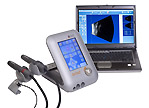
Immersion Vector A/B-scan Biometry.
The immersion B-scan/vector A/B-scan technique prevents corneal
compression and the two-dimensional B-scan display helps guide the superimposed
vector A-scan for measurements directly to the fovea.
An immersion echogram through the posterior fundus is obtained using a horizontal axial B-scan approach. The goal is to center the cornea and lens echoes in the echogram while simultaneously displaying the optic nerve void near or slightly above the center. The A-scan vector is then adjusted so as to pass through the middle of the cornea as well as the anterior and posterior lens echoes. Such alignment assures that the vector will intersect the retina in the region of the fovea. This technique is particularly important when the macula lies on the sloping wall of the staphyloma.

Figure E - The B-scan is oriented horizontally with the vector A-scan
going through the center of the cornea (C), anterior lens (L1) and posterior
lens (L2).
With this alignment, the vector A-scan will intersect the retina at
the approximate center of the macula, just below the void of the optic nerve.
This technique has the advantage of the operator being able to direct the
axial length measurement to the region of the fovea, giving the refractive,
rather than the anatomic axial length. For an eye with a mature cataract,
or a high axial myope, with a peripapillary posterior staphyloma, this is
the preferred biometry technique by ultrasound.
The immersion B-scan/vector A-scan technique is still limited by the resolution
of a 10-MHz sound wave and variations in retinal thickness around the fovea.
However, it does allow for direct visualization of the area being measured
and, as a result, has even better consistency than that the immersion A-scan
technique.
The main drawbacks are that the equipment is more expensive, there is a greater
level of skill required and the measurements do take longer to carry out.
 For further reading, we highly recommend the
book A-scan Axial Length Measurements by Sandra Frazier Byrne.
For further reading, we highly recommend the
book A-scan Axial Length Measurements by Sandra Frazier Byrne.
Also, there is an excellent, national certification
program in Ophthalmic Biometry available for your technicians:
American Registry of Diagnostic Medical
Sonographers.
|