Applanation
A-scan Biometry.
A-scan biometry by applanation requires that the ultrasound probe be placed directly on the corneal surface. This can either be done at the slit lamp, or by holding the ultrasound probe by hand.
Even in the most experienced hands, some compression of the cornea is unavoidable;
this typically being 0.14 mm - 0.28 mm.
The popularity of the applanation method is due to how quickly it appears to be accomplished.
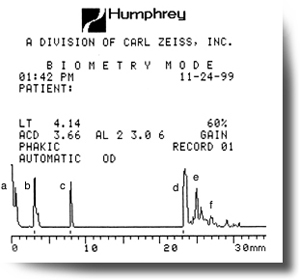
Figure A - Phakic axial length measurement using the applanation method.
a: Initial spike (probe tip and cornea)
b: Anterior lens capsule
c: Posterior lens capsule
d: Retina
e: Sclera
f: Orbital fat
Note: When echoes b through d are high and steeply rising, the ultrasound beam is most likely on axis. The scleral echo should easily be identified and the orbital fat echoes should descend quickly and at a steep angle. If there are no scleral or orbital fat echoes visible, the ultrasound beam is most likely aligned with the optic nerve rather than the macula.
Figure B - Note the typical applanation measurement
variations.
Measurements taken by applanation method will frequently show variability from one to the next, as a result of inconsistent corneal compression, and will be seen even under the most experienced guidance.
The way to avoid this is to change to the immersion technique, as described below.
 For further reading, we highly recommend the
book A-scan Axial Length Measurements by Sandra Frazier Byrne.
For further reading, we highly recommend the
book A-scan Axial Length Measurements by Sandra Frazier Byrne.
Also, there is an excellent, national certification
program in Ophthalmic Biometry available for your technicians:
American Registry of Diagnostic Medical
Sonographers.
|