Calculating the Effective Lens Position.
Reducing your prediction error to a minimum.
Dr. Holladay first published the quadratic solution to
the axial length vergence formula, in 1993, for the effective
lens position, or ELPo, previously referred to as
the anterior chamber depth, or ACD.
Determining the ELPo allows you to calculate the optimal, or "personalized" lens
position based on your individual experience with any style lens,
averaged ideally from 20 to 30 cases. You can then use this figure
with the IOL power calculation formulas. Details on this topic can
be found in the following two articles listed below, which are highly
recommended:
|
Holladay JT: Refractive Power Calculations for Intraocular Lenses in the
Phakic Eye. AJO 1993; 116: 63-66 |
Holladay JT: Standardizing constants for ultrasonic biometry,
keratometry, and intraocular lens power calculations.
J Cataract Refract Surg 1997; 23: 1356 - 1370 |
A nice feature of the Holladay
IOL Consultant is that it will do this calculation for you, with
automatic updates as outcomes are entered. For those of you who do
not yet have this software, determining the ELPo is a valuable exercise,
reducing your prediction error to a minimum. Follow this link to view an
example of how to set up an ELP Spreadsheet for tracking outcomes.
Below is a step-by-step outline:
Step 1: The ultrasonic axial length (ALu) for each case
must be converted to the optical axial length (ALo). This corrects for
the difference between the location of the secondary principal plane
of the cornea (Pc2 = +0.05 mm) and the thickness of the retina, the
distance between the vitreoretinal interface and the visual cell layer
(Rt = +0.25 mm).
Step 2: The keratometric power of the cornea (Kk) for
each case must be converted to the net optical power of the cornea
(Ko). This corrects for the fact that the non-physiologic standardized
keratometric index of refraction (set more than 100 years ago) is
1.3375, but the true physiologic corneal index of refraction is
1.3333, or 4/3.
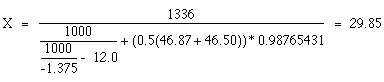
Step 3: The following equations are Holladay's reverse
solution to the axial length vergence formula for the ELPo. This
assumes that the following are known: the postoperative keratometry
(Kk), the preoperative axial length (ALu), the stabilized actual
postoperative refraction (APostRx); the vertex distance (V), and the
power of the implanted intraocular lens (IOLe). For plus power IOLs,
the sign in front of the square root is negative and for minus power
IOLs (as would be implanted in the setting of high to extreme myopia),
the sign in front of the square root is positive.
Example 1 - Capsular Bag Placement:
Below is an example
of the calculated postoperative ELPo for the Alcon MA60BM acrylic
posterior chamber intraocular lens placed within the capsular bag. The
corrected ultrasonic axial length (ALo = 22.28 + 0.20) is 22.48 mm,
the postoperative refraction ( APostRx ) at six weeks is -0.50 D, the
vertex distance ( V ) is 12.0 mm, the postoperative keratometry is
46.87 / 46.50 x 090, and the power of the implanted lens ( IOLe ) is
+22.50 D.
Example 2 - Ciliary Sulcus Placement:
Below is an example
of the calculated postoperative ELPo for the Alcon MA60BM acrylic
posterior chamber intraocular lens that has been implanted into the
sulcus. The corrected ultrasonic axial length (ALo = 22.28 + 0.20) is
22.48 mm, the postoperative refraction ( APostRx ) at six weeks is
-1.375 D, the vertex distance ( V ) is 12.0 mm, the postoperative
keratometry is 46.87 / 46.50 x 090, and the power of the implanted
lens ( IOLe ) is +22.50 D. Note that even though all parameters have
remained the same as the previous example, the more anterior position
of the IOL in the sulcus has resulted in a greater degree of
myopia.
|