Limbal Relaxing Incisions.
Improving outcome predictability
|
My friend Rafi Israel in California has has adjusted the output of
the
PalmScan
AP2000 LRI equation to account for the fact that LRIs also need
to consider corneal rigidity, which is a function of both IOP and corneal
thickness.
As we learned in college (when we were paying attention),
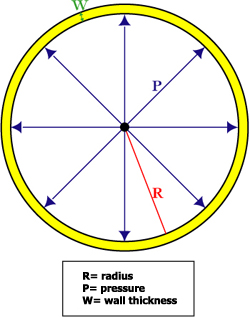
the tension on the wall of a sphere, such as the cornea, can be
described by LaPlace's Law, where...
| |
The tension (T) in the spherical object...
with a wall thickness of (d)...
and the internal pressure (p)...
and the radius of (r) is:
T = (p*r) / (2d) |
|
|
 |

The more rigid the cornea, the more effective will be the cut and the
thicker the cornea, the deeper the cut will need to be in order to
have the desired effect. This is a very well-reasoned approach and Dr. Israel
has shown that applying a correction based on LaPlace's Law does
indeed increase the accuracy of the exercise.
Follow this link for a more detailed explanation: Micro
Medical Devices (no financial interest).
LRI's carried out in this manner require an adjustable diamond blade and a
good method of intraoperative marking. What many consider to be the best instruments
for this purpose can be found at: Mastel
Precision (no financial interest).


