| |
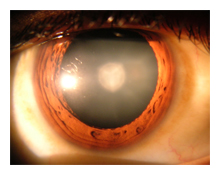
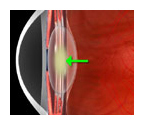
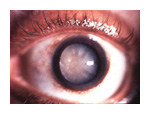
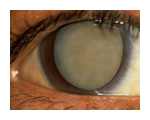
 cloudiness, glare and double vision
|
Colors may not appear as brilliant as they once did. People might comment
on the fact that you are now wearing brighter clothing, heavier make-up, or
your hair is dyed an unfamiliar hue. These are all very natural, normal
compensations for viewing your world through cloudy-yellowed cataracts.
You don't have to be a senior citizen before noticing these symptoms. People
can have age-related cataracts in their forties and fifties, although those
are most often in the beginning stages and rarely affect vision. It is typically
during the mid-sixties when vision becomes impaired enough to cause interference
and strongly suggest having cataract surgery.

TOP
How Are Cataracts Detected?
Although you may think you have a cataract, there
is only one way to know for sure, by having an eye examination by a qualified
ophthalmologist. If you are over sixty years old, you should have an eye examination
at least once every two years. Once each year is not too much.
Your eye exam should absolutely include dilating your pupils. This means
drops are put into your eyes that make your pupils open up, or enlarge temporarily
in a fixed position. The pupil is the internal opening between the front
and back of the eye, like a tiny window that you look through. Minute muscles
make the iris close or open, thus controlling the amount of light coming
in.
A cataract can be detected without dilating the pupils, but dilating the
eyes allows plenty of light onto the back of your eye, which is essential
for finding potential problems. Getting a good view of the retina and optic
nerve is used for early detection of eye diseases such as glaucoma and macular
degeneration.
When Should Cataracts Be Removed?
Just having a cataract does not mean that you must undergo surgery. Even if your ophthalmologist finds a cataract, you may not need to have it removed for several years. In fact, you might never need cataract surgery. A change in your eyeglass prescription may satisfactorily improve vision
for a while. Magnifying lenses or stronger lighting may facilitate daily activities. However, if your cataracts interfere with your everyday activities, such as reading or driving, you do not have to put up with them.
The time to consider cataract surgery is highly individual. As a rule, when your vision falls below 20/40, you will notice a significant impact on daily functioning. To what degree will vary from person to person. A pilot, for example, may require surgery in the earliest stage of cataract development, while someone with considerably lesser demands might not be bothered by a much denser development.
Eventually, safety considerations may be a factor, as a developing cataract steadily limits a person's involvement in a normal, independent lifestyle.
Cataracts can be hazardous when they substantially interfere with your ability to see street signs, traffic lights or freeway exits, drive at night, step off curbs or steps, recognize faces, cook, iron, read medicine labels, or write checks, and sign binding documents.
As this is a highly individual matter, it is one you should discuss with your physician. By having your vision tested regularly, you can gather enough information to make an informed decision.
Are Cataracts Harmful To Your Eyes?
Leaving a cataract in the eye is not harmful except in very rare situations. In most cases, surgery can be postponed for as long as the patient desires, or not done at all. The only side effect would be the less clarity of vision. Over time,
cataracts do increase in size and hardness, and if the cataract is very
advanced, the surgery can be more difficult to perform. However, even
then, the result is usually very good.
How Are Cataracts Treated?
Cataract surgery is the only way to remove a cataract.
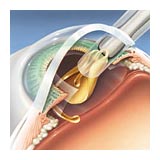
Cataract surgery requires removing
the cloudy lens and replacing it with a new clear implantable lens, called
an intraocular lens (IOL) or lens implant.
Patients with beginning cataracts, may notice that their vision is sometimes
improved by using different eyeglasses, magnifying lenses, or even stronger
lighting. These options do not really treat the problem of the crystalline
lens becoming clouded. There are no medications, eye
drops, exercises, or glasses that will cause cataracts to disappear.
Your cataract needs to be removed
when it interferes with your everyday activities, such as driving, reading,
or watching TV. It is important that you and your eye surgeon make that decision
together. In most cases, waiting until you are ready to have cataract surgery
will not harm your eye. If you have cataracts in both eyes, your surgeon will
remove them one at a time in order to achieve the best possible results.
Sometimes,
it is necessary to remove a cataract, even if it doesn't seem
to cause problems with your vision, if it prevents a thorough
examination of the retina or optic nerve, or treatment of another eye problem,
such as age-related macular degeneration or diabetic retinopathy.
Click
on the following links to learn more about CATARACT SURGERY.
Premium Intraocular
Lens Implants and the Correction
of Astigmatism, in conjunction with IOL
Power Calculations are
advancements in cataract surgery that East Valley Ophthalmology has
actively participated in developing.
The eye specialists of East Valley Ophthalmology perform advanced
technology diagnostic testing and treatment, as well as taking
the time necessary to provide each patient with information needed
to fully understand their condition and to achieve their best possible
visual outcome.
If you would like further information, please call our office at:
480-981-6111
East Valley Ophthalmology
Eye Doctors - Mesa, ArizonaIf you or a family member
or friend have not had a recent routine eye examination, have a specific eye condition that needs addressing, or are looking for
an eye specialist or professional eye consultant please take a moment to Request an Appointment.
|