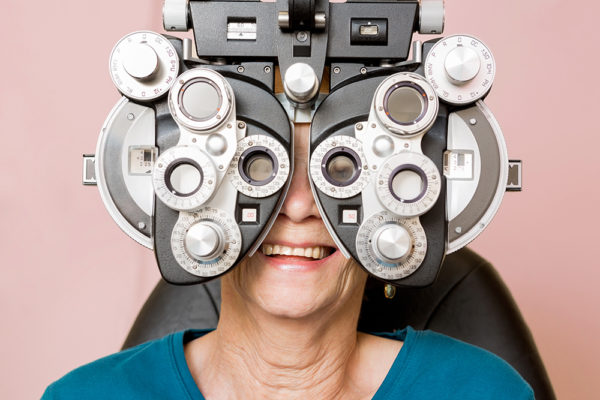
Part of the examination, such as taking your medical history and the initial eye test, may be performed by a technician who assists your doctor. Your eye doctor will review this information before examining you.
A complete eye exam involves a series of tests designed to evaluate your vision and check for eye diseases. All of it is painless. Your doctor may use odd-looking instruments, aim bright lights directly at your eyes, and request that you look through a seemingly endless array of lenses. Each test evaluates a different aspect of your vision.
We want you to feel completely at ease during your eye exam. If some part of the process is confusing to you, please ask for further explanation. If you have any additional questions later, please don’t hesitate to call us. There are no foolish questions, only ones you want answered, and we encourage you to ask. Additionally, we provide printed materials about various eye conditions that you can take home.
What tests are used during an eye exam?
Eye exams involve more than testing your vision and, if you need glasses or contacts, determining how strong your correction should be. Additional tests assess the appearance and health of all parts of your eyes.
In addition to these basic evaluations, you may require more specialized tests, depending on your age, medical history, and risk of developing eye disease.
This test assesses the muscles that control eye movement, seeking to identify weakness or poor control. Your eye doctor looks at your eyes as you move them in six specific directions and as you visually track a moving object, such as a pen.
Tonometry measures your intraocular pressure — the pressure inside your eyes. It helps your eye doctor detect glaucoma, a disease that causes pressure to build up inside your eyes and can cause blindness. Glaucoma can be treated if it’s caught early.
Methods your eye doctor may use to test your eyes for glaucoma include:
Applanation tonometry
This test measures the amount of force required to flatten a part of your cornea temporarily. Fluorescein, the same orange dye used in a regular slit-lamp exam, is usually put in your eye to make your cornea easier to see. You’ll also receive eye drops containing an anesthetic. Using the slit lamp, your doctor moves the tonometer to touch your cornea. It won’t hurt, and the anesthetic will wear off within two hours.
Noncontact tonometry
This method uses a puff of air to test the pressure in your eye. No instruments will touch your eye so you won’t need an anesthetic. You’ll feel mild pressure on your eye, which can be uncomfortable, but it lasts only seconds.
Pachymetry
This test measures the thickness of your cornea — an essential factor in evaluating your intraocular pressure measurement. After applying numbing eye drops, your eye doctor uses an instrument that emits ultrasound waves to measure your corneal thickness.
Refraction refers to how light waves are bent as they pass through your cornea and lens. A refraction assessment helps your doctor determine a corrective lens prescription that will give you the sharpest vision. If you don’t need corrective lenses, you won’t have a refraction assessment.
Your doctor may use a computerized refractor to measure your eyes and estimate the prescription you need to correct a refractive error. Or he or she may use a technique called retinoscopy. In this procedure, the doctor shines a light into your eye and measures the refractive error by evaluating the movement of the light reflected by your retina.
Your eye doctor fine-tunes this refraction assessment by asking you to look through a Phoroptor, a mask-like device that contains wheels of different lenses, and judge which combination gives you the sharpest vision. By repeating this step several times, your doctor determines the lenses that provide you with the greatest possible acuity.
A retinal examination — sometimes called ophthalmoscopy or fundoscopy — examines the back of your eye, including your retina, optic disk, and the underlying layer of blood vessels that nourish the retina (choroid). Usually, before your doctor can see these structures, your pupils must be dilated with specific eye drops. The eye drops may sting briefly and might cause a medicinal taste in your mouth as the medication drains from your tear ducts into your throat.
After administering eye drops, your eye doctor may use one or more of these techniques to view the back of your eye:
Direct examination
Your eye doctor shines a beam of light through your pupil and uses an ophthalmoscope to see the back of your eye. Sometimes eye drops aren’t necessary to dilate your eyes before this exam. You might see afterimages when your eye doctor stops shining the light in your eyes. This is normal and will resolve on its own.
Indirect examination
For this exam, you might lie down or recline in a chair. Your eye doctor will hold each eye open and examine it with a bright light mounted on his or her forehead — a bit like a miner’s lamp. This exam lets your eye doctor see your eye in great detail and in three dimensions. Since this light is brighter than that in a direct examination, you are more likely to see afterimages, but they disappear quickly.
Slit-lamp exam
In this exam, your doctor uses the slit lamp along with the ophthalmoscope to look at the back of your eye. The slit lamp reveals more detailed views of the back of your eye than do direct or indirect examinations.
The retinal examination takes five to 10 minutes, but if you’re given eye drops, their effects won’t wear off for several hours. Your vision will be blurry, and you’ll have trouble focusing your eyes. You may not be able to drive, so ensure you have an alternative means of transportation back to work or home. Depending on your job, you may not be able to work until the eye drops have worn off.
A slit lamp is a microscope that enlarges and illuminates the front of your eye with an intense line of light. Your doctor uses this light to examine the cornea, iris, lens, and anterior chamber of your eye.
When examining your cornea, your doctor may use eye drops containing fluorescein (flooh-RES-ene) dye. The orange dye spreads across your eyes to help your eye doctor detect tiny cuts, scrapes, tears, foreign objects, or infections on your cornea. Your eyes’ tears will wash the dye away.
This test measures your ability to see clearly from a distance. Your technician will ask you to identify different letters of the alphabet printed on a chart positioned usually 20 feet away. The lines of type get smaller as you move down the chart. You cover one eye and read aloud, then cover the other eye and read aloud.
Your visual field is the area directly in front of you that you can see without moving your eyes. The visual field test determines whether you have difficulty seeing in any areas of your peripheral vision — the areas on the side of your visual field. There are a few different types of visual field tests:
Confrontation visual field exam
Your eye doctor sits directly in front of you and asks you to cover one eye. You look directly at your eye doctor while he or she moves his or her hand in and out of your visual field. You tell your doctor when you can see their hand.
Tangent screen exam
You sit a short distance from a screen and stare at a target at its center. You tell your doctor when you can see an object move into your peripheral vision.
Automated perimetry
Your eye doctor uses a computer program that flashes small lights as you look into a special instrument. You press a button when you see the lights.
By gathering information based on your responses to one or more of these tests, your eye doctor makes a map of your peripheral vision. If you aren’t able to see in certain areas, your eye doctor uses the map to help diagnose your eye condition.
Treatment and Follow-up:
After the examination, your doctor will assess and evaluate the test results to determine a diagnosis and develop a treatment plan. The two of you will discuss the nature of any visual or eye health issues found and explain available treatment options. In some cases, referral for consultation with, or treatment by, another eye doctor or healthcare provider may be indicated.
It is essential to follow your eye doctor’s instructions for using medications, such as eye drops. It is equally important that you keep all scheduled follow-up appointments. Some eye conditions require regular, careful monitoring.
Suppose any aspect of the care is to be delegated to another doctor or healthcare provider. In that case, you should verify that they are fully qualified and licensed to provide medical care following surgery. Worth repeating, should you have any concerns, we enthusiastically encourage you to ask questions!