In summary: The cornea and the inside lens focus light from an image onto the retina. The amount of light entering the eye is controlled by the opening and closing of the pupil. Light sensitive cells on the back of the eye, called the retina, create electrical impulses that travel to the brain where it forms an image that you recognize as sight.
The diagram above shows the main parts of the eye.
- Cornea – the clear covering of the front of the eye.
- Sclera – the white part of the eye.
- Iris – the colored part in the center of the eye, works like a round muscle, expands and contracts to control the amount of light coming in.
- Pupil – the black center of the eye surrounded by iris tissue that gets smaller and larger, depending on the amount of light.
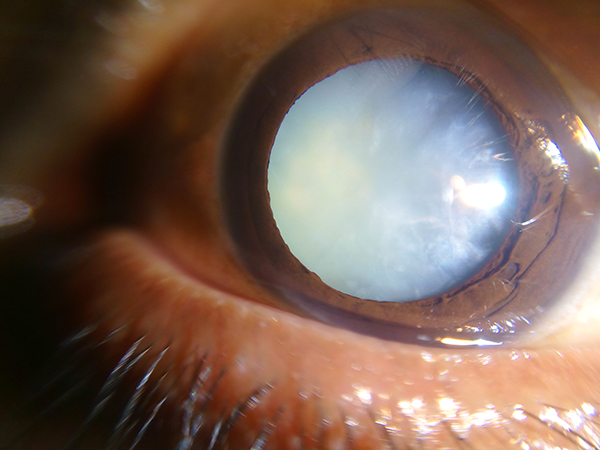
- Crystalline lens – behind the pupil that directs light to the back of the eye. This is the part that becomes cloudy and is then called a cataract.
- Posterior capsule – following cataract surgery this helps to hold the crystalline lens in place and separate from the vitreous body.
- Retina – light-sensitive tissue that covers the back of the eye.
- Macula – the center of the retina where fine vision takes place.
- Optic nerve – this relays impulses to the brain where they translated into vision.
Similar to a Camera.
 Your eyes functions similar to the parts of a camera. Both the camera and your eye have an internal lens that focuses an image onto a film. The retina can be compared to camera film, consisting of a thin layer of photosensitive cells.
If the lens of a camera were smudged or scratched, the pictures would turn out blurred. Similarly, as the crystalline lens in your eye becomes cloudy and yellowed by cataract formation, your picture of the world is blurred and discolored.
Two Lenses — One Inside, One Outside
 As we mentioned above, the eye is a two-lens system. The lens on the outside at the front of the eye is the cornea and the lens inside the eye behind the iris is the crystalline lens. Light travels through the cornea and through the crystalline lens bending as it goes through each one to concentrate upon the retina at the back of the eye. The retina collects the variations in light and sends that to the brain via the optic nerve. The brain then translates this into an image of whatever is in front of you, allowing you to “see” it. The conscious part of your mind within your brain does the actual seeing — it’s almost miraculous how it happens!
A young, perfect lens is transparent, meaning it is absolutely clear. If either of the two lenses (the cornea or crystalline) is not clear and light rays are unable to pass through completely, the retina collects inaccurate information. The image sent to the brain is then difficult to translate and what we experience is cloudy or blurry images. This could happen if you were to get oil in your eye that temporarily coated the cornea. Or if your crystalline lens becomes cloudy when forming a cataract.


 Cataract surgery is the only cure for cataracts. Modern cataract surgery is a safe, effective, and relatively standard procedure. In fact, if you have been told that you have a cataract, you are definitely not alone. Each year in the United States, more than 3 million people have cataract surgery!