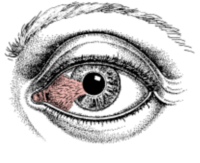
A pinguecula is a common type of growth on the white part of the eye, appearing as a yellow spot or bump. It often appears on the side of the eye nearest the nose. A pinguecula is a deposit of protein, fat, or calcium. It looks fatty (in Latin, the word pinguiculus means “fattish”), and is the result of an accumulation of connective tissue.
Pinguecula
Pterygium
A pinguecula is a growth next to the cornea. A pterygium is a growth of the conjunctiva next to the cornea that spreads across onto the cornea.
What is a pterygium?
The plural form of the word is pterygia (pronounced te-ri-gi-a). Pterygia are shaped like a wedge or winglike triangle (in Greek, the prefix pteryg means “wing”)
A pterygium may start as a pinguecula, a growth of fleshy tissue that may grow onto the cornea. As a pterygium grows, its appearance can vary from minor and pink to large and angry red, accompanied by symptoms of dry eye. Eventually, it may cause visual disturbances by disrupting the usually smooth surface of the cornea. In severe cases, a pterygium can completely block a patient’s vision. A pterygium can occur in both eyes, typically on the side of the eye nearest the nose.
At East Valley Ophthalmology, our corneal specialists perform pterygium removal surgery, which includes the complete excision of the lesion. A conjunctival autograft typically covers the area.
A pinguecula is rarely surgically removed and is usually treated with a steroid eye drop. However, the eye drops do not eliminate the pinguecula. If it is a primary cosmetic concern or if it causes discomfort or interferes with blinking, the pinguecula may be surgically removed. Surgery is only done in severe cases, as there is a high rate of recurrence after pinguecula surgery.
Pterygia are more common in sunny climates and in the 20-40 age group. Scientists do not know the exact cause, which could be due to prolonged exposure of the eyes to wind and weather, or an inherited disorder caused by a single gene. However, since people who have pterygia usually spend a significant amount of time outdoors, many doctors believe that ultraviolet (UV) light from the sun may be a factor. Pterygia are more common among individuals who spend a significant amount of time outdoors, such as landscapers and surfers, but anyone can develop a pterygium. In areas where sunlight is strong, wearing protective eyeglasses, sunglasses, and/or hats with brims is suggested. While some studies report a higher prevalence of pterygia in men than in women, this may reflect different rates of exposure to UV light.
A pterygium grows predominantly from the nasal side of the sclera due to the shadow that is cast by the nose; the cornea acts as a lens for sunlight on the nasal side, but not on the lateral (or temporal side). The nasal side is also the drainage area for the eye, so all dust particles move to the nasal side, irritating it.
The most effective method of preventing a pterygium is to wear UV400-rated sunglasses regularly when outdoors in sunny conditions. Reducing your sun exposure between 10:00 a.m. and 2:00 p.m. is highly recommended. Sunglasses with a wrap-around design provide better protection than those with significant gaps between the sunglasses frame and the skin around the eyes. Wearing a hat with a wide brim offers valuable additional protection.
In cases where a pterygium is not actively growing onto the cornea, protecting the eyes from ultraviolet light may often stabilize its growth. Provided it is not threatening vision, this may be all that is required. Otherwise, management with eye drops is usually effective.
Typically, pterygium surgery is only undertaken if the pterygium causes troublesome symptoms. In cases where the pterygium is threatening to distort vision, the only effective treatment is pterygium surgery.
Pterygium surgery is performed under a general anaesthetic as a minimally invasive, day procedure. Although the procedure itself takes less than half an hour, you should expect to be at the surgery center for approximately 6 hours. Because of the medications you will have received, you won’t be able to drive yourself home, so make sure to arrange for someone to take care of you. You might be slightly groggy from the sedation. You will be given medication for discomfort, should you experience any.
You’ll be lightly sedated to ensure that you’re relaxed and comfortable. Your eye will be numbed entirely, and although you’ll be aware of your surroundings, you won’t be able to see.
The pterygium is first carefully peeled and cut away. To reduce the risk of regrowth, your surgeon will harvest a tissue graft from beneath your upper eyelid and place it over the removal site. The healthy graft tissue retards the growth of any remaining sun-damaged cells in the affected part of the eye. The graft is secured with tissue glue and tiny sutures, which usually dissolve.
Your eye will heal rapidly. You’ll be able to return to work in about two days.
After you are discharged from the day unit, your eye will be patched. The patch is to remain on your eye until your postoperative appointment the following morning. Avoid strenuous activity for approximately one week following your pterygium surgery. For several days after the surgery, you may experience some discomfort, and pain relief may be required. Be sure to inform your corneal specialist if you are experiencing any severe symptoms.
You will be given eye drops to use six times per day for the first week. At your one-week postoperative appointment, your corneal specialist will instruct you on the frequency of drop use until your next appointment. The adhesive used to secure your graft will dissolve on its own after the first week. Over the next two to four weeks, your eye will gradually return to its normal appearance, with little to no trace of redness or irritation. Recovery times vary between patients. Typically, complete healing is achieved within one month, provided there are no complications.
A pterygium can grow back after it has been removed. A recurrent pterygium often grows more rapidly than the initial pterygium. While our corneal specialists use the best treatments to try to prevent the recurrence of pterygium, the risk of this happening in each particular case is not predictable. One in every 10 patients may have a regrowth.
Pterygium surgery generally has excellent outcomes. However, despite excellent surgical removal, the pterygium may return, particularly in younger people or in those under constant exposure to irritants. Recurrence occurs in less than 5 percent of cases. Even in the absence of recurrence, in an additional 5 percent of cases, the site of pterygium removal remains red. Medications that slow tissue growth can sometimes be helpful.
Although rare, other risks of pterygium surgery may include:
During the healing process, some patients have significant pain and may require prescription pain relief
The site at which the pterygium was excised may be red for a prolonged period
Wound infection is uncommon, but if it occurs, treatment with antibiotics would be necessary
Bleeding is uncommon and should be reported to your corneal specialist immediately
The feeling of ‘grit in the eye,’ irritation, and dryness may persist
Some scarring of the cornea may follow pterygium surgery. This is usually mild and does not commonly affect vision unless the pterygium is very large
A granuloma or ‘proud flesh’ may develop where the pterygium was removed. This usually resolves with prescribed eye drops
Pterygia and pinguecula are benign conditions, not malignant (i.e., not cancerous). They do not invade the eye, sinuses, or brain. They do not spread to other parts of the body.
Although a pinguecula and pterygium are non-cancerous, you should report any changes in size, shape, or color of any bump on your eyeball to your corneal specialist.