What Is Glaucoma?

“Sneak Thief of Sight”

Often called the sneak thief of sight, glaucoma can destroy sight without causing any pain or noticeable symptoms until it is too late. Early detection of glaucoma is critical.

Glaucoma is one of the leading causes of blindness throughout the world, affecting approximately 2% of the population over the age of 40. When diagnosed early enough, this disease can often be successfully treated and blindness prevented.

A complex eye disease, glaucoma is not simply an elevated intraocular pressure. Glaucoma is a broad term used to describe a range of eye conditions that damage the optic nerve and potentially cause loss of vision. Glaucoma, therefore, is a disease of the optic nerve, the vital nerve bundle that carries images to your brain so you can see.

Glaucoma usually affects both eyes, but can progress more rapidly in one eye than in the other. Involvement of just one eye primarily occurs when glaucoma is brought on by factors such as a prior injury or the use of steroids in that eye.

The eyeball is basically a rigid sphere filled with aqueous humor. In the normal eye, there is a constant production and drainage of this fluid. This production and drainage is balanced to maintain a “normal’ intraocular pressure (IOP). As the total amount of fluid within the eye increases, so does the pressure within it. Many people relate glaucoma to increased pressure inside the eye, although that is not the only cause; but it is a common cause of glaucoma. The higher the pressure inside the eye, the greater the chance of damage to the optic nerve.

Imagine a healthy eye as a water balloon attached to a faucet that is permanently dripping water. The balloon features a drainpipe that slowly filters water out at a constant rate, allowing the balloon to remain perfectly full without overextending itself. However, if the drainpipe were clogged, the water would collect inside the balloon and over-inflate it, creating too much pressure. Eventually, the most fragile part of the balloon would become damaged and give way.

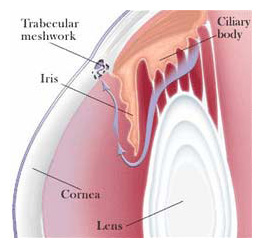
In your eye, the liquid is called aqueous humor and constantly flows in and out, not as a part of the tears on the outer surface, but rather coming from inside your eye and leaving through a drainpipe called the angle (because of its angular shape). If the angle becomes blocked, the volume of fluid inside the eye exceeds normal levels, placing excessive pressure on the fragile optic nerve and potentially damaging it (see illustration at the top of this page).

glaucoma meshwork diagram

The diagram above shows the front part of the eye in cross-section to illustrate the filtering or drainage angle. The angle is between the cornea and the iris, which join each other right where the drainpipe, trabecular meshwork, is located. The purple arrow in the diagram shows the flow of the aqueous fluid from the ciliary body, through the pupil, and into the drainage channels.

Glaucoma can affect anyone. While high pressure in the eye is considered the primary reason for glaucoma, even patients with normal eye pressure have been known to contract this disease. If detected early, loss of vision can most often be prevented. Factors that increase a person’s risk generally include:

  • Increased Intraocular Pressure (IOP)
    Anyone who has been found to have an elevated intraocular pressure at a glaucoma screening or as part of a general eye examination is considered to be at risk for developing glaucoma.
  • Increasing Age
    The incidence of glaucoma increases with age. Typically, the incidence of glaucoma becomes much more noticeable above the age of 40 years old. This is why routine eye examinations with glaucoma evaluation are recommended every two years above the age of 40, unless there is a family or medical history of glaucoma, or other predisposing health factors.
  • Race
    African Americans have certain genetic factors that cause a higher likelihood of developing glaucoma.
  • High Blood Pressure
    Patients who are medically treated for high blood pressure may be at a greater risk for glaucoma due to the lowering of blood pressure within the optic nerve.
  • Family History of Glaucoma
    Family history of glaucoma is a very significant risk factor. If any other family members have been diagnosed with glaucoma, your risk of developing glaucoma increases considerably. This is particularly true for siblings of glaucoma patients, who have a 5-fold increase in risk for developing glaucoma.
  • Diabetes
    Anyone being treated for diabetes is considered to be at greater risk for glaucoma due to the general circulation problems associated with diabetes.
  • Myopia (nearsightedness)
    In general, nearsighted patients often have anatomical features that may increase their risk of developing glaucoma.
  • Long-term Steroid Treatment
  • Injury/Trauma To The Eye

Your eye doctor will weigh all of these factors before deciding whether you need treatment for glaucoma or whether you should be monitored closely as a glaucoma suspect, meaning your risk of developing glaucoma is higher than usual. You need to have regular eye examinations to detect the early signs of damage to the optic nerve.

Yes, glaucoma is not a single disease; it encompasses many types, primarily falling into two main groups, plus secondary forms. You will see the word “angle” in the different glaucoma names. This is because the eye’s drainage system is called the angle, named for its angular shape. The angle lies between the cornea and the iris, and is primarily how the two main groups of glaucoma are differentiated:

  • Open-angle glaucoma — which allows fluid to accumulate — develops over time.
  • Closed-angle glaucoma — fluid is blocked from entering, acute, occurs suddenly.

By far, the most frequently diagnosed type of glaucoma in the United States is primary open-angle glaucoma (POAG). Patients with primary open-angle glaucoma typically demonstrate an increase in intraocular pressure (IOP) upon routine measurement. The increased intraocular pressure results from either too much aqueous humor being produced or too little being drained. This fluid buildup within the closed space of the eye’s interior elevates the pressure. It is this raised pressure that can cause permanent damage to the optic nerve, resulting in vision loss.

Since the optic nerve is the connection between the retina and the brain and is responsible for communicating visual images, damage to the optic nerve can result in vision loss. This is why it is so vital to monitor, detect, and control intraocular pressure. If left untreated, an elevated intraocular pressure may, over time, cause slow, progressive, and permanent damage to the optic nerve, which can result in blindness.

Initially, open-angle glaucoma has no symptoms. There is no pain or noticeable change in vision. Loss of peripheral (vision off to the side) is the earliest symptom. Left untreated, the field of vision will continue to narrow, leading to tunnel vision, eventually to blindness.

Acute angle-closure glaucoma is an emergency and should be treated immediately. Closed-angle glaucoma occurs when fluid cannot escape because the drainage angle is blocked, causing pressure to build up suddenly. This often causes noticeable pain.

Angle closure glaucoma is found much less frequently than open-angle glaucoma, but it can produce considerable vision loss in a short period of time. While there can be several causes of closed-angle glaucoma, it is most often caused by anatomical changes within the internal structures of the eye.

Acute closed-angle glaucoma is structurally different from open-angle glaucoma. With closed-angle glaucoma, the fluid in the eye cannot reach the drainage meshwork (trabecular meshwork) because clogging occurs before the meshwork. In contrast, with open-angle glaucoma, the clogging is within the drainage meshwork itself.

The trabecular meshwork is actually a tiny tissue filter that, if blocked by a change in size or shape of the tissue, will cause the intraocular pressure to elevate. In instances where the meshwork becomes blocked abruptly, it causes a sudden rise in intraocular pressure. This sudden rise in pressure can cause pain, redness, blurred vision, and, if left untreated, permanent loss of vision.

Closed-angle glaucoma is considerably more common in farsighted eyes, which tend to be smaller, and in patients between the ages of 45 and 60, where the crystalline lens is beginning to swell.

During your general eye exam, if your eye doctor observes or measures a narrowed angle, they will perform an additional examination procedure called Gonioscopy to fully visualize the meshwork and the angle, carefully assessing your predisposition to angle closure glaucoma. This test is performed by placing a special contact lens on the eye and then using the slit lamp biomicroscope to examine the meshwork and the angle thoroughly. If you are at risk for angle closure glaucoma, or if you have acute angle closure glaucoma, the most effective form of treatment is to use a laser to produce a small opening or hole in the iris so that aqueous humor can quickly and efficiently drain from the eye by preventing the trabecular meshwork from being blocked.

Glaucoma resulting from congenital, ocular, or systemic conditions represents secondary glaucoma.

The six most common forms of secondary glaucoma:

  • Exfoliation syndrome
  • Pigmentary glaucoma
  • Neovascular glaucoma
  • Lens-induced glaucoma
  • Glaucoma accompanied by ocular inflammation
  • Trauma-induced glaucoma

Routine eye examinations are of vital importance because, in its early stages, glaucoma usually has no symptoms. To be controlled, glaucoma must be diagnosed early. It is a lifelong disease, so those afflicted must be compliant for the rest of their lives and religiously keep to their scheduled eye exams and with their medication regimens.

  • Measuring your intraocular pressure (tonometry)
  • Inspecting the drainage angle of your eye (gonioscopy)
  • Evaluating any optic nerve damage (ophthalmoscopy)
  • Testing the visual field of each eye (perimetry)

Some of these tests may not be necessary for every person. You may need to repeat these tests regularly to determine if glaucoma damage is increasing over time.

  • Under age 45
    • With risk factors = every 2 years
    • Without risk factors = every 4 years
  • Over age 45
    • With risk factors = every year
    • Without risk factors = every 2 years
Development of Glaucoma

Time for a yearly eye exam?

How important are routine eye exams? If you just passed a “vision screening” — do you still need a comprehensive eye exam?