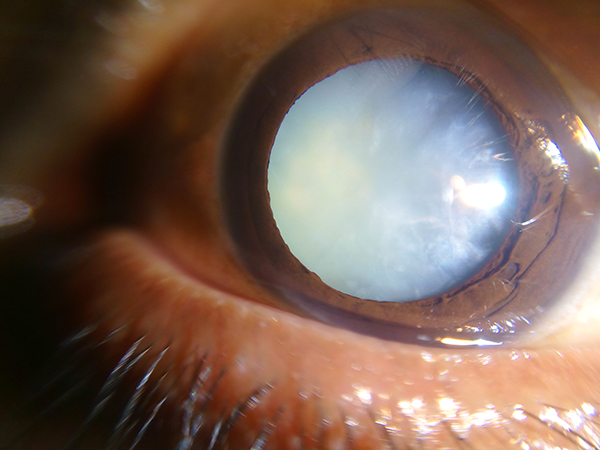
Cataracts
Why does my vision seems cloudy?
Two significant changes occur in your eyes as you progress through your 50s and 60s, affecting your vision. First, the lens inside your eye begins to lose its flexibility, making it more difficult to see clearly at all distances – this condition is called presbyopia. Eventually, the lens will also lose its transparency, and your ability to see clearly overall decreases – this vision change is called a cataract.
A cataract generally occurs because, as you age, the crystalline lens inside your eye very gradually becomes yellow and cloudy. Your ability to see well in dim light situations, such as driving at night, becomes impaired. This cloudiness may also cause glare and light sensitivity. If the lens becomes too cloudy, you may notice a significant decrease in both daytime and nighttime vision. You may not even notice the change for quite some time, until one day you ask, “What happened?”
Click on each section below to view its contents:
How does the eye work?
The cornea and the inside lens focus light from an image onto the retina. The amount of light entering the eye is controlled by the opening and closing of the pupil. Light-sensitive cells on the back of the eye, called the retina, create electrical impulses that travel to the brain, where they form an image that you recognize as sight.

The diagram above illustrates the primary components of the eye.
- Cornea – the clear covering of the front of the eye.
- Sclera – the white part of the eye.
- Iris – the colored part in the center of the eye, works like a round muscle, expands and contracts to control the amount of light coming in.
- Pupil – the black center of the eye surrounded by iris tissue that gets smaller and larger, depending on the amount of light.
- Crystalline lens – behind the pupil that directs light to the back of the eye. This is the part that becomes cloudy and is then referred to as a cataract.
- Posterior capsule – following cataract surgery, this helps to hold the crystalline lens in place and separate it from the vitreous body.
- Retina – light-sensitive tissue that covers the back of the eye.
- Macula – the center of the retina where fine vision takes place.
- Optic nerve – this relays impulses to the brain, where they are translated into vision.
Similar to a Camera.
 Your eyes function similarly to the parts of a camera. Both the camera and your eye have an internal lens that focuses an image onto a film. The retina can be compared to camera film, consisting of a thin layer of photosensitive cells.
If the lens of a camera were smudged or scratched, the pictures would turn out blurred. Similarly, as the crystalline lens in your eye becomes cloudy and yellowed by cataract formation, your image of the world is blurred and discolored.
Two Lenses — One Inside, One Outside
 As we mentioned above, the eye is a two-lens system. The lens on the outside at the front of the eye is the cornea, and the lens inside the eye, behind the iris, is the crystalline lens. Light travels through the cornea and the crystalline lens, bending as it passes through each to concentrate on the retina at the back of the eye. The retina collects the variations in light and sends them to the brain via the optic nerve. The brain then translates this into an image of whatever is in front of you, allowing you to “see” it. The conscious part of your mind within your brain does the actual seeing — it’s almost miraculous how it happens!
A young, perfect lens is transparent, meaning it is absolutely clear. If either of the two lenses (the cornea or crystalline) is not clear and light rays are unable to pass through completely, the retina collects inaccurate information. The image sent to the brain is then challenging to translate, and what we experience are cloudy or blurry images. This could happen if you were to get oil in your eye that temporarily coats the cornea. Or if your crystalline lens becomes cloudy when forming a cataract.
What are cataracts?

It is common for people to think of a cataract as a film that grows over their eyes. However, a cataract does not form on the eye, but rather inside the eye.
The eye is a two-lens system. There’s a lens on the outside, front part of the eye called the cornea, and a lens on the inside called the crystalline lens. When the inside lens gets cloudy, that is called a cataract.
Cataracts are a natural part of the aging process. Almost everyone reaching their mid-sixties has some form of cataract in one or both eyes. Cataracts do not cause irreversible blindness. A cataract can occur in either or both eyes. They do not spread from one eye to the other. They are not a growth that covers the surface of the eye, a tumor, or a disease, but simply a change in the clarity of the natural lens. However, certain diseases can lead to the formation of cataracts.
The word “cataract” derives from the Latin “cataracta,” meaning a waterfall. The term may have been initially used metaphorically to describe the appearance of a mature cataract. For a person with a well-developed cataract, life is viewed as though seen through a sheet of water or a window that is fogged with steam.
Most people who develop cataracts are older, although cataract development can occur for various reasons at any age. By age 80, more than half of all Americans either have a cataract or have had cataract surgery. Read more about cataract surgery.
What are the symptoms of a cataract?
The most common symptoms of a cataract are:
- Cloudy or blurry vision.
- Colors seem faded.
- Poor night vision.
- Glare. Lights may appear too bright. A halo may appear around lights.
- Double vision or multiple images in one eye.
- Frequent prescription changes in your eyeglasses or contact lenses.
- A loss of image contrast.
These symptoms can also be a sign of other eye problems. If you experience any of these symptoms, please get in touch with us.
What causes cataracts?
There are some causes of early cataracts, such as smoking, diabetes, or receiving a harsh blow to the eye. However, the lens typically changes naturally over time.
The crystalline lens is located behind the iris and the pupil. This lens works much like a camera lens. It focuses light onto the retina, a network of nerves at the back of the eye. A young, healthy lens flexes to adjust our focus, letting us see things clearly both up close and far away.
The lens is made mostly of water and protein. The protein is arranged in a precise manner that keeps the lens clear and allows light to pass through it. As we age, some of the protein in the lens may become irregular, leading to areas of cloudiness within the lens. This is a cataract. Over time, these areas may grow larger and cloud more of the lens, making it harder to see. A mature cataract blocks all vision.
What are the risk factors for cataract formation?
The primary risk factor is aging. However, you don’t have to be a senior citizen to develop cataracts. People can develop an age-related cataract in their 40s and 50s, although during middle age, most cataracts are minor and do not significantly affect vision. It is after age 60 that most cataracts begin to interfere with a person’s vision.
Other risk factors for cataract include:
- Certain diseases (diabetes, for example).
- Personal behavior (smoking, alcohol).
- Environmental (prolonged exposure to ultraviolet sunlight).
Are cataracts reversible?
No — The crystalline lens inside the eye naturally clouds as it ages. This process is unavoidable. However, its progress may be slowed by not smoking, eating a healthy, balanced diet, and wearing sunglasses with 100% UVA and UVB protection.
Do close-up tasks make cataracts worse?
No — Cataracts may become more noticeable during close work, so you may think that is the cause, but cataracts are not at all caused by how people use their eyes. You can safely read in near darkness if you want to without “ruining” your eyes, but if you are developing cataracts, reading in dim light will eventually become more difficult due to a loss of contrast. One sign of developing a cataract is the need for more light to do the same activities well.
Can eye drops dissolve cataracts?
Save your money; the answer is absolutely no. There are no drops that can cure or delay cataracts. The FDA would likely be eager to approve such drops if they existed and were proven to be safe and effective. Some such products claim they can prevent cataracts. Other products claim they can dissolve cataracts. However, cataracts are not a substance on the lens but rather a natural aging process occurring inside and intrinsic to the entire lens itself.
No drops, exceptional food, or treatments will make a cataract go away. We sincerely wish it were true; how much easier that would be! There is no cure for cataracts other than the surgical removal of the lens and its replacement with an artificial lens. Fortunately, modern cataract surgery and some very impressive lens replacements are proven and available.
What is the cure for cataracts?
 Cataract surgery is the only cure for cataracts. Modern cataract surgery is a safe, effective, and relatively standard procedure. In fact, if you have been told that you have a cataract, you are definitely not alone. Each year in the United States, more than 3 million people have cataract surgery!
Thanks to advanced cataract surgical procedures and lens implant technology, cataract surgery is not only one of the most frequently performed surgical procedures in the United States, but it is also one of the safest and most successful surgical procedures that you can have. Cataract surgery is a relatively quick procedure, performed on an outpatient basis, typically requiring only a few hours of your time from start to finish.
Do I need cataract surgery?
A cataract needs to be removed only when vision loss interferes with your everyday activities, such as reading, driving, or watching television. Symptoms of an early cataract may be improved with a new eyeglass prescription, brighter lighting, anti-glare sunglasses, or the use of magnifying lenses. If these measures do not help, it may be time for cataract surgery. A comprehensive eye exam with a trusted ophthalmologist is the only way to know for sure.
Sometimes a cataract needs to be removed even if it does not cause problems with your vision. For example, a cataract should be removed if it prevents examination or treatment of another eye problem, such as age-related diabetic retinopathy or macular degeneration. Occasionally, if the cataract becomes very large, it can displace the iris (the colored part of the eye), leading to a condition known as angle closure glaucoma.
Once you understand the benefits and risks of surgery, you can make an informed decision about whether cataract surgery is right for you. In most normal cases, delaying cataract surgery will not cause long-term damage to your eye or make the surgery more difficult. You do not have to rush into surgery.