An amazing transformation of YOUR vision!
East Valley Ophthalmology cataract surgeons in Mesa, AZ, are among the leading cataract surgery specialists in the United States and are recognized as experts worldwide. We are recognized as the destination for other doctors to send their complex and unusual cases. Our surgeons specialize in the mathematics of intraocular lens power calculations and offer cataract, cornea, and glaucoma patients options that were previously unavailable to others.
Which type of cataract surgery is right for you?
For patients planning to have cataract surgery, East Valley Ophthalmology offers a choice of two surgical options:
- Traditional cataract surgery
The most common surgery in the world is recognized as being safe and effective. - Advanced, laser-assisted cataract surgery
In the proper situation, laser cataract surgery may provide some advantages in terms of precision and consistency. It costs more than traditional cataract surgery and is not typically covered by most insurance plans.
How do you decide?
Discuss available options with your ophthalmologist to determine the best type of surgery for you. Cataract surgery is designed to improve your vision and reduce your dependency on glasses or contact lenses. For some people, simply replacing a cloudy lens with a clear lens implant and wearing glasses for some activities is perfect. For others, achieving the best possible vision without glasses after cataract surgery is the goal. Understanding your vision needs and expectations can help you and your surgeon decide the best option for you.
Cataract Surgery FAQs
Click on each section to view its contents.
 A cataract is a clouding of the lens inside the eye that affects vision. Cataract formation is a natural part of the aging process. Almost everyone reaching their mid-sixties has some form of cataract in one or both eyes. Cataracts do not spread from one eye to the other. They are also not a growth that covers the surface of the eye, such as a tumor or disease, but rather a change in the clarity of the natural lens.
 A comprehensive

 It is perfectly normal to be a bit apprehensive before any unfamiliar experience. All this information about cataracts and surgery may seem odd or a little frightening to you. That’s okay because we will walk you through it and make your experience as smooth and straightforward as possible.
 Cataract surgery is one of the most successful surgeries of all, but just as crossing an empty street can be risky, so too are there risks involved with any surgery. The only way to avoid all risk is to do nothing.
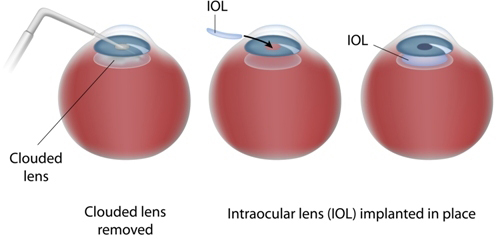
 Not so long ago, cataract surgery involved making an incision large enough to remove the clouded lens in one piece. Patients often stayed at the hospital overnight or for several days. With the aid of new technologies, cataract surgery can be performed through a tiny incision and typically occurs on an outpatient basis, resulting in a significantly shorter recovery time.
 No — Occasionally, the membrane that holds the lens implant in place becomes cloudy with a thin film of scar tissue that forms on the posterior capsule behind the new implant lens. This may be referred to as a secondary cataract, but is more accurately called capsular haze or posterior capsule clouding. Patients sometimes think their cataract has grown back, but it hasn’t. Once a cataract has been removed, it will not recur.