|
doctor-hill.com Carl Zeiss Meditec IOL Master  |
IOLMaster — IOL Calculations
|
 |
WARNING: This step is necessary ONLY with corneas pretreated by refractive surgery. With untreated corneas, IOL calculation is started instantly upon selection of the biometric formula (see: IOL Calculation). |
Refractive History Method
The following values must be known:
- Preoperative corneal refraction (i.e., before corneal refractive surgery
- Preoperative refraction
- Stable postoperative refraction
- Corneal vertex distance.
As the change in refraction was achieved by variation of the corneal refraction, the current effective corneal refraction directly results from the difference between preoperative and postoperative refraction, corrected by the corneal vertex distance (vertex correction).
The computational method is described in the technical literature. If the corresponding data of the patient are available, the refractive history method delivers the most accurate results.
For the calculation of the IOL, the Corneal K's selected by the examiner with APPLY will be transferred to the IOL calculation table. The IOL calculation can be started after selection of the biometric formula.
Contact Lens Method
The following parameters are needed:
- Refraction with contact lens
- Refraction without contact lens
- Refractive power of the (plane or almost plane) hard contact lens - refractive power of contact lens back surface and
- Corneal vertex distance.
In the ideal case, the refractive power of the contact lens back surface is equal to the unknown corneal refraction. For this purpose, several hard plane contact lenses with refractions of the back surface between 30 and 45 D should be available. For the calculation of the corneal refraction, enter the appropriate patient data into the display mask. The values will now be calculated.
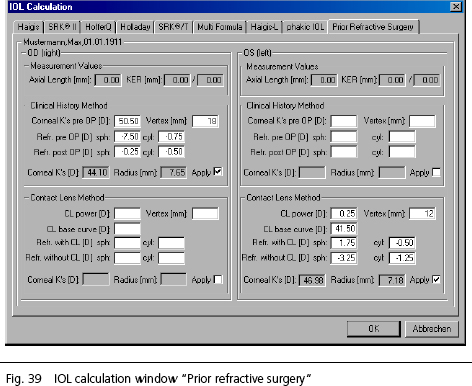
For the calculation of the IOL, the Corneal K's selected by the examiner with APPLY will be transferred to the IOL calculation table. The IOL calculation can be started after selection of the biometric formula.
|
WARNING: The calculated refractive power/radii values may NOT be edited in the IOL Calculation window for the selected formula. |
The corneal K's transferred to the IOL calculation are marked in the printout of the lens calculation with (**) and the calculation method.
In contrast to the above-described methods of determining corneal refraction, the Haigis formula allows for surgical changes to the cornea and permits the calculation of the IOL from the measured values AL, Corneal K's and ACD.
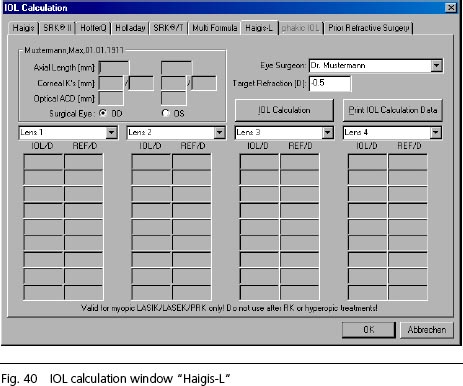
| WARNING: This method may only
be used for eyes with myopic LASIK, myopic PRK and myopic LASEK.
Lenses by hyperopic LASIK/LASEK/PRK or myopic/hyperopic RK should never be calculated. The corneal |
For further information: