|
IOLMaster — Keratometer Tips.
Adjust
Keratometer Measuring Marks
Ask the patient to relax and look at the yellow  fixation light. If the patient
cannot see the fixation light, he or she should look straight ahead
into the IOLMaster. fixation light. If the patient
cannot see the fixation light, he or she should look straight ahead
into the IOLMaster.
 |
|
Note
The peripheral infrared measuring marks are invisible to the patient. However,
in a darkened room an attentive observer may perceive the measuring marks
as faint red dots when looking into the projectors of the keratometer. |
When adjusting the IOLMaster, make sure that all the 6 peripheral points
are visible and located in the field between the two auxiliary circles,
as closely as possible to the center of the display. The images of the
measuring marks on the display must be optimally focused by varying the
distance between patient and device. The images of the measuring marks
should be circular or ellipsoid. Provided the traffic light function
has been activated, a green light will appear when the measurement setting
is optimum.
To improve the reflectivity of the cornea, it is advisable to ask the
patient to close and open the eyes several times. This replenishes the
tear film and improves the imaging of the measuring marks (on a regular
cornea). Artificial tears may also be used. Ask the patient to open his
or her eyes WIDE and take the measurement. The appropriate reminder will
appear below the video image when the keratometer mode is activated.
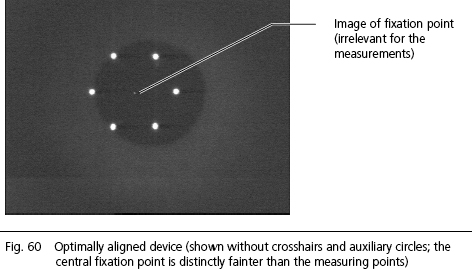
|
|
Note
Depending on the reflectivity of the cornea, the image of the fixation point
may be barely visible. This is irrelevant for the calculation of the corneal
curvature, as the position of the fixation point will not be evaluated. |
Keratometer Measurement Errors
The "Error" message
may have two basic causes:
-
The results of the internal individual measurements vary by more than 0.05 mm
(very rare, defocused device).
-
The measuring marks are either indiscernible or not recognized properly. (The
marks not recognized will be shown on the screen after the measurement).
The possible reasons for this are described below.
Defocused Keratometer
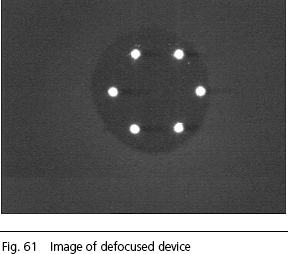

The images of the measuring marks are too large, because the IOLMaster is
defocused. The system cannot calculate a measured value and "Error" appears
in the display field.

The measurement can be retaken after correcting the focus adjustment to minimise
the peripheral mark size. Sometimes, with exactly adjusted focus, small circles
(like haloes) may be visible around the six peripheral measuring points. In
this case, focusing is optimal.
Concealed Measuring Marks
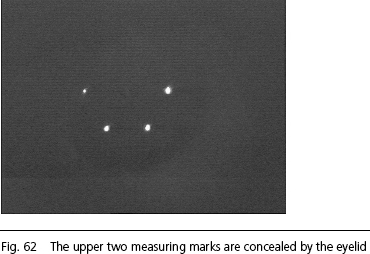
The display field shows the "Error" message. This error
may also occur if the patient blinks during the measurement
(0.5s). This is particularly the case with restless or anxious patients.
Ask the patient to open his or her eyes WIDE and repeat the measurement.
If this does not resolve the problem, carefully pull up the upper eyelid without indenting the globe.
 |
|
WARNING:
Take care not to deform the eyeball.Pressure
on the globe causes a deformation of the cornea and results in incorrect
radius and refraction measurements.
|
Pseudophakic Eyes
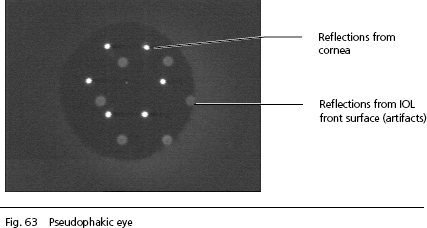
In the measurement of pseudophakic eyes, images of the measuring marks
may be visible at the front of the intraocular lens beside the reflections
of the cornea. The reflections from the IOL are fainter and lack definition.
Try moving the IOLMaster approximately 1 mm away from the patient’s
eye (defocusing) and take the measurement. The images produced at the cornea
will now be slightly larger, while the artifacts of the IOL become fainter,
such that the evaluation process may not identify them as measuring points;
a measurement is then possible. If this procedure does not succeed, the corneal
curvature cannot be measured.
Dry Eyes
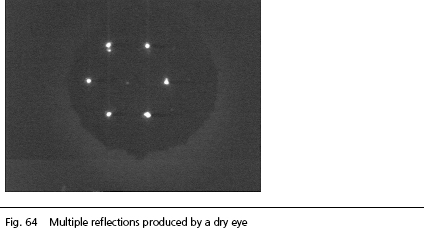
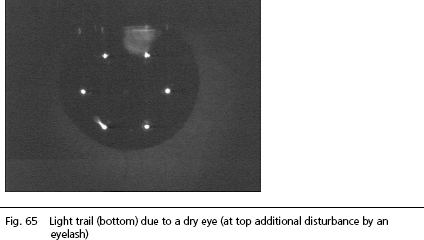
If the tear film is suddenly interrupted, the reflectivity of the cornea will
be greatly reduced at these points and the cornea will scatter the light more
strongly. If a measuring mark is projected to such a region, the otherwise
circular or ellipsoid image of the measuring mark will become irregular. Irregular
marks and/or multiple reflections will form. In this case, a precise measurement
of the corneal curvature will not be possible. The results will fluctuate or
the "Error" message will be displayed.
Ask the to patient blink several times to replenish the tear film on the cornea,
then take the measurement immediately or use a tear supplement to prevent rapid
drying.
Irregularities of the Corneal Surface (Scars)
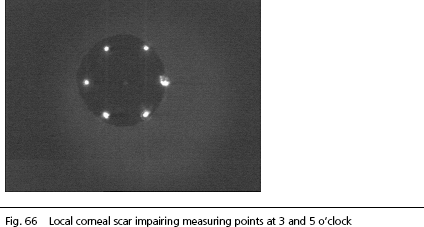
Scars and local irregularities on the corneal surface impair the imaging quality
of the measuring marks. Depending on the extent and location of the artefacts,
measuring errors may occur.
Try to position the measuring mark adjacent to, above or below the scar by
slightly displacing the IOLMaster relative to the eye, then take a measurement.
In such cases, it is advisable to repeat the measurement several times. Depending
on the degree of irregularity, fluctuations or measuring errors may occur.
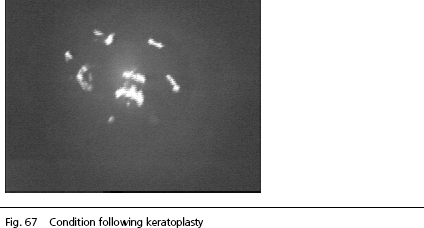
|
|
Note In this case, keratometer measurements cannot be taken with the IOLMaster.
|
|
