| 
Best Technique for ALM
Measuring axial length with the
IOL Master allows a high degree of
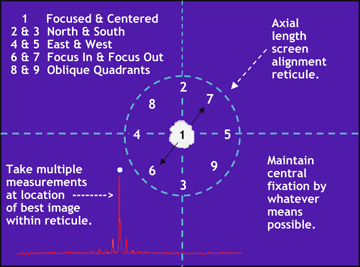
flexibility. Rather than simply positioning a small, in-focus image in the
middle of a set of video screen cross hairs, you can instead maneuver the
focusing spot anywhere within the measurement reticule, and even focus in,
or focus out.
In this way, it is possible to sample different areas around
the visual axis until the best axial length display is obtained.
Then, once that best spot is discovered, all subsequent measurements
are taken from that location. This technique is especially useful
for eyes with small corneal scars, anterior cortical spokes, posterior
subcapsular plaques, or other localized media opacities.
If the signal-to-noise ratio of the eye to be measured is borderline
(2.0 to 1.6), focusing in, or focusing out, in such a way that
that focusing spot enlarges to about the same size as the measurement
reticule, will sometimes significantly improve the quality of the
axial length display. This is possible with the IOL Master because
axial length measurements by partial coherence interferometry are
distance independent.
It is useful to take all 20 measurements. At least four of these
measurements should be within 0.02 mm of one another, and should
exhibit the characteristics of an Ideal Display.
An ideal axial length display is more important than a high signal-to-noise
ratio (SNR).
Remember to instruct your patient to look directly at the small
red fixation light. In this way, axial length measurements will
be made to the center of the macula, giving the refractive axial length,
rather than the anatomic axial length.
If there is a high refractive error (more than ±4.00 D),
you can even take several measurement with the patient's glasses
in place to ensure adequate fixation. Measurements with and without
glasses should be exactly the same. For eyes with high to extreme
myopia, with a type 1 peripapillary posterior staphyloma, being
able to measure to the fovea is an enormous advantage over conventional
A-scan ultrasonography.
|
