doctor-hill.com Carl Zeiss Meditec IOL Master  |
IOLMaster — Axial Length Measurement |
|
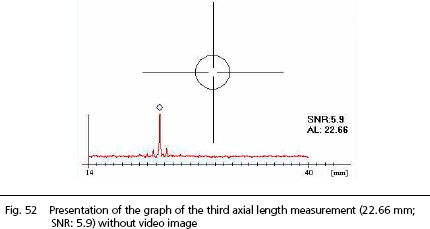
SNR > 2.0 --> Measured value is valid. |
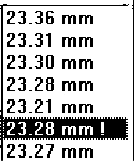 |
SNR in the range 1.6...2.0 --> Measured value is uncertain.
Reasons for Low Signal-to-Noise Ratio
- Dense medial opacity along the visual axis
- Restless patients
- Alignment of device to patient eye is not optimal
- Very high ametropia (> 6 D)
- Corneal scars
- Pathological changes in the retina.
 |
Note In this case, "Borderline SNR" does not mean an incorrect result, it is only to remind you to verify this measurement! |
Accurate signal peaks can be determined by comparison with other values of the measurement series of this eye (and of the other eye, if necessary). See: Signal curves of axial length measurements, and Shifting the measuring cursor (below).
SNR < 1.6 (Measured value should not be used) |
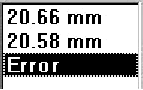 |
It is marked on the display as an erroneous result.
This means that the true measuring signal does not stand out sufficiently from the noise. As a rule, the results of such measurements are not usable and should be rejected. They can be deleted from the list by using the <DEL> key once they are highlighted.
|
Note Measuring errors (display: Error) are not taken into account in the mean value calculation! |
The reading may be transferred to the list of measured values by clicking on the measuring cursor (white dot). In doing so, ensure that the measured values are consistent.
Shifting the Measuring Cursor
The measuring cursor (white dot) is automatically placed on the center of the signal peak with the highest absolute amplitude. The corresponding axial length value is displayed beside the graph and in the display field.
The SNR is calculated and displayed for this signal peak. The measuring cursor is placed in the center between the regions corresponding to half the maximal amplitude. If the signal curve is symmetrical (Gaussian curve), the cursor is positioned exactly above the maximum of the signal.
There are two ways to shift the measuring cursor to another peak; it is recommended that these manipulations be carried out in a zoom view of the measurement curve.
Automatic Positioning Over a "Distant" Peak
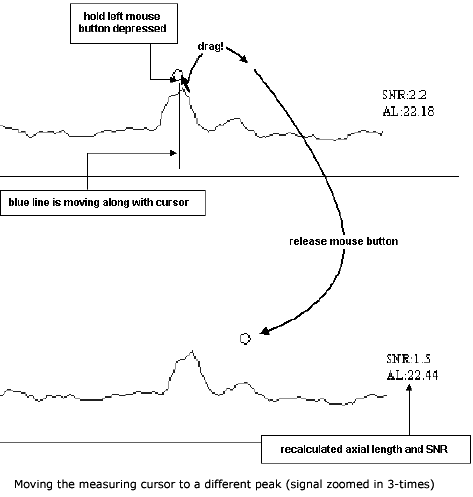
- Place the arrow cursor on the white dot, hold the left button depressed and move the measuring cursor over the other peak. For easier orientation, a vertical blue line will appear below the white dot. This line can be dragged with the cursor.
- When the button is released, the measuring cursor automatically snaps in over the desired peak.
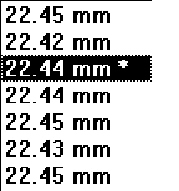 |
The display will show the corresponding axial length value and SNR (always smaller than the maximal SNR found automatically) and the recalculated measured value will appear in the display field denoted by an asterisk (*). |
|
Note This manipulation will work only if the measuring cursor is moved across the (local) maximum of the desired target peak. This procedure is necessary for the search algorithm to reliably find the desired peak without returning and snapping in to the original (higher) peak. Closely adjacent peaks (double peaks) cannot be separated by this automatic method unless the curve adjoining them drops down below a value which is less than half the amplitude of their maxima. |
|
Note While dragging the measuring cursor, the original axial length value and SNR remain displayed beside the signal curve. The new axial length value and corresponding SNR will be calculated and displayed only when the button is released. |

|
Note This manipulation should always be done in a zoomed view! See: Zooming Display. |
Fine-Shifting the Measuring Cursor
- Proceed as described above under Item 1, but use the right button to drag the measuring cursor. This way the automatic peak detection is deactivated and the white dot can be positioned at any point over the measuring curve.
- When the button is released, the current axial length and the new SNR will be calculated and displayed.
This kind of manipulation is advisable with closely adjacent double or triple peaks.
Here again, the recalculated axial length measurement is shown in the display field with an asterisk (*).
|
Note Even if the manipulations are undone with the measuring cursor (by moving it back to the automatically found maximal peak) and the measured value agrees with the original one, the asterisk after the measured value will remain, indicating that the curve has been deliberately manipulated. |
The described manipulations of the measuring cursor may be performed both in axial length measurement mode (after the current individual measurement) and in post measurement editing mode.