|
IOLMaster — IOL Power Calculations.
If all measured values have been determined
(depending on the calculation formula) the surgeon can use the IOL Master
to generate IOL options to match his/her surgical and postoperative
requirements. Before the system calculates IOL options, you must have entered
the desired lens types into the database. See: IOL
Database.
<I> key, or the IOL
icon, activates the IOL Calculation mode.
The IOL power calculation window will appear, in which the measured values
of both eyes are automatically entered. Depending on the choice of
refractive power/radii in the Program Settings submenu,
the keratometer readings are displayed in either Corneal K values (D) or
Radii (mm).
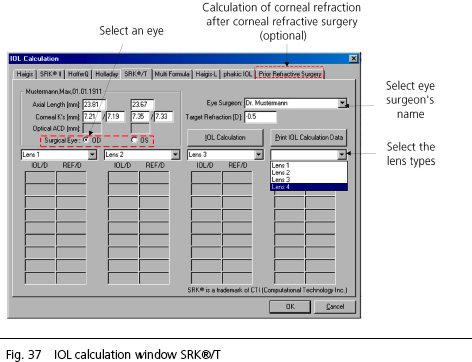
- Click on the appropriate tab to select the desired formula. The
Haigis, HofferQ, Holladay, SRK II, and SRK/T formulas are
implemented as standards.
- After refractive corneal surgery, the Haigis-L or Prior Refractive
Surgery tabs may be selected.
- Selected phakic lens implants may be calculated with the Phakic IOL tab.
- Select the eye surgeon's name. This gives the surgeon access to lens
types saved to his or her database.
- The measured values may be edited if desired.
 |
WARNING: Readings appearing with an asterisk
(*) in the printout of the lens calculation have been edited and are
no longer based on the IOLMaster readings. Using these numbers
may result in refractive errors. |
- Select an eye for which the IOL is to be calculated on the screen.
- Enter the desired target refraction. No entry means 0 D (plano).
- Select suitable lenses from the lens types shown.
- After you have entered the necessary data, click on the IOL
CALCULATION button. This will start IOL calculation of each lens type
selected. The calculation will be performed for every measured eye.
However, only the data of the selected eye is displayed on the
screen.
- To change the display, select the other eye under Eye for surgery.
The lenses calculated for the other eye will now be displayed.
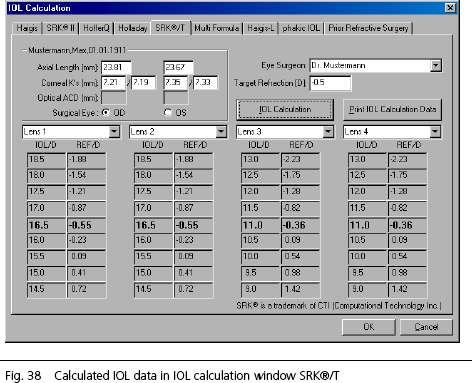
In the columns below each specified lens you will find the calculated
refractive powers and target refractions for those lenses. The middle line
appearing in bold type indicates which refraction of the corresponding
IOL comes closest to the desired target refraction.
|
WARNING:
The IOL calculation is valid ONLY if the biometric
measurement was correct, an appropriate IOL calculation formula was selected,
and the IOL constants were optimized for this specific application. |
The data calculated for the IOL to be implanted can be printed out.
- For this purpose, click on the PRINT button.
The IOL data of both eyes or of one eye and emmetropic IOL will be
printed out either on a single page or on separate pages, depending
on the option selected in the Program Settings menu (page 33).
- Click on OK to finish IOL calculation.
|
